

Associate Chief Nurse
Department of Emergency Nursing, Xuanwu Hospital, Capital Medical University, China
Abstract:
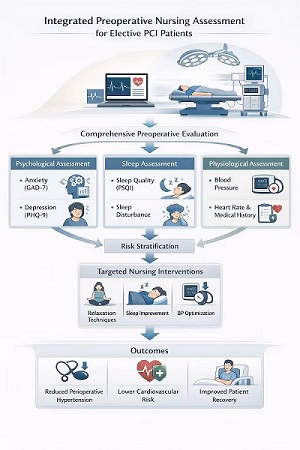
Background: Preoperative blood pressure elevation is frequently observed in patients undergoing elective percutaneous coronary intervention (PCI) and may increase perioperative cardiovascular risk. Conventional preoperative assessments primarily focus on physiological indicators, while psychological distress and sleep disturbances are often underrecognized. Growing evidence suggests that anxiety and poor sleep quality may influence autonomic nervous system activity and blood pressure regulation. However, these factors are rarely systematically incorporated into routine nursing evaluation before PCI. Integrating psychological and sleep assessment into preoperative nursing practice may provide a more comprehensive approach to early risk identification.
Methods: This retrospective observational study included 286 adult patients scheduled for elective PCI at a tertiary hospital between September 2023 and February 2024. Based on preoperative blood pressure measurements, patients were categorized into a normal blood pressure group (n=94) and an elevated blood pressure group (n=192). Psychological status and sleep quality were assessed using validated instruments, including the Generalized Anxiety Disorder-7 (GAD-7), Patient Health Questionnaire-9 (PHQ-9), and the Pittsburgh Sleep Quality Index (PSQI). Demographic characteristics, clinical variables, and lifestyle factors were extracted from electronic medical records. Multivariable logistic regression analysis was conducted to identify independent predictors of preoperative blood pressure elevation.
Results: After adjustment for potential confounders, anxiety (OR=4.85, 95% CI: 2.30–10.26, P<0.001), sleep disturbance (OR=2.78, 95% CI: 1.45–5.34, P=0.002), and higher baseline systolic blood pressure (OR=1.05 per mmHg increase, 95% CI: 1.03–1.06, P<0.001) were independently associated with preoperative blood pressure elevation. Depression was not identified as an independent predictor in the multivariable model. These findings highlight the significant influence of psychological and sleep factors on perioperative blood pressure stability.
Conclusions: Psychological distress and sleep disturbance play an important role in preoperative blood pressure elevation among elective PCI patients. Integrating psychological and sleep screening into routine preoperative nursing evaluation may improve early identification of high-risk patients and support the development of targeted nursing interventions. Such an integrated assessment approach may enhance perioperative risk management and contribute to more patient-centered cardiovascular nursing care.
Biography:
Xuelian Sun is an Associate Chief Nurse and Head Nurse of the Emergency Department at Xuanwu Hospital, Capital Medical University, Beijing, China. She has extensive clinical and management experience in emergency nursing and cardiovascular patient care. Her research interests focus on perioperative nursing assessment, cardiovascular risk management, and psychological factors affecting patient outcomes. She is actively involved in clinical nursing practice, nursing education, and research on improving perioperative nursing evaluation and patient safety.
© 2026 Mathews International LLC. All rights reserved.
